
At a recent exhibition at the Honolulu Museum of Art, a series of oblong forms invited visitors to do something they might not expect at a museum: Touch the art. Modeled after the ceramic sculptures displayed throughout the exhibition—a major retrospective of the acclaimed artist Toshiko Takaezu—the hanging vessels were made to be lifted and shaken, encouraging you to rattle the contents enclosed within.
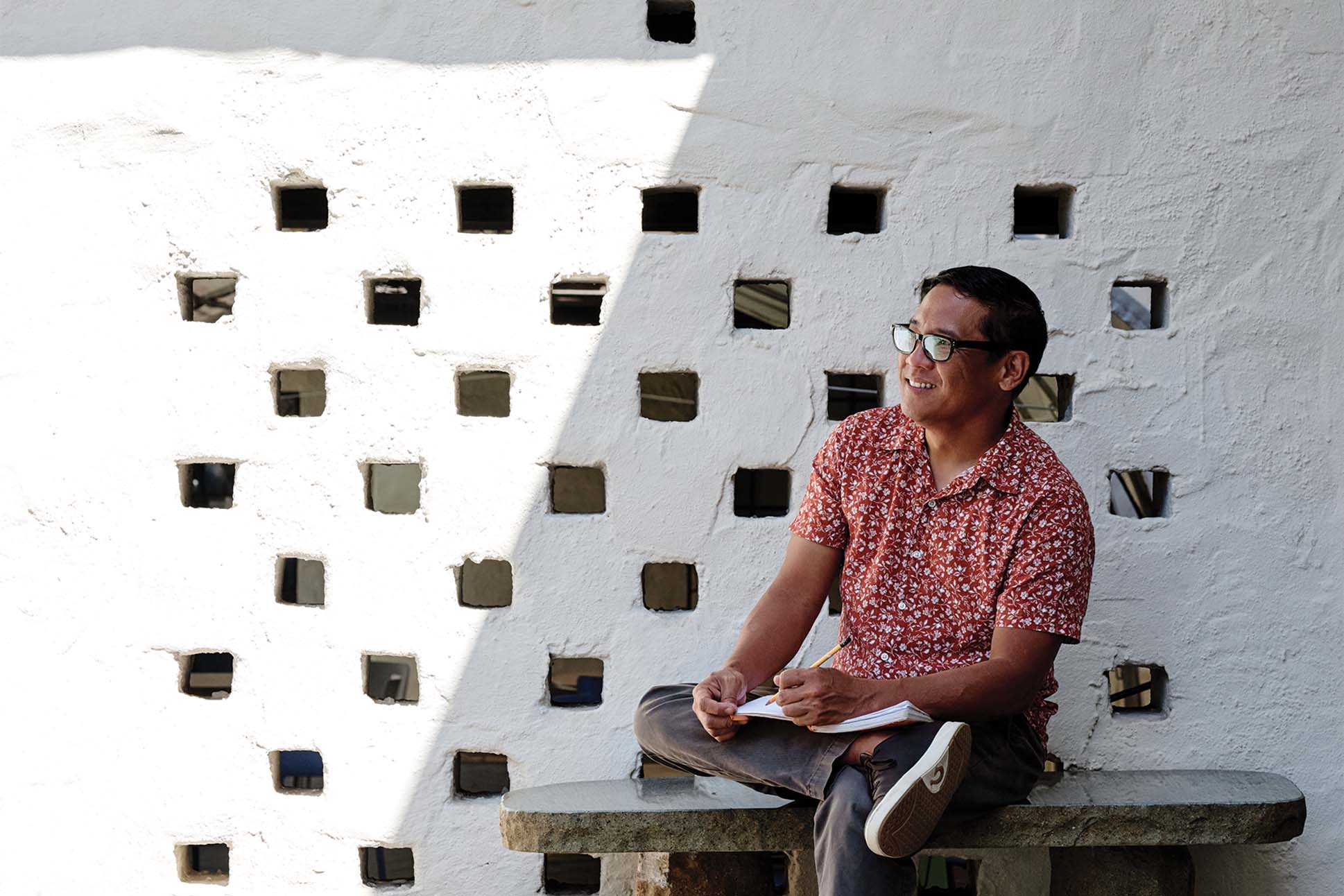
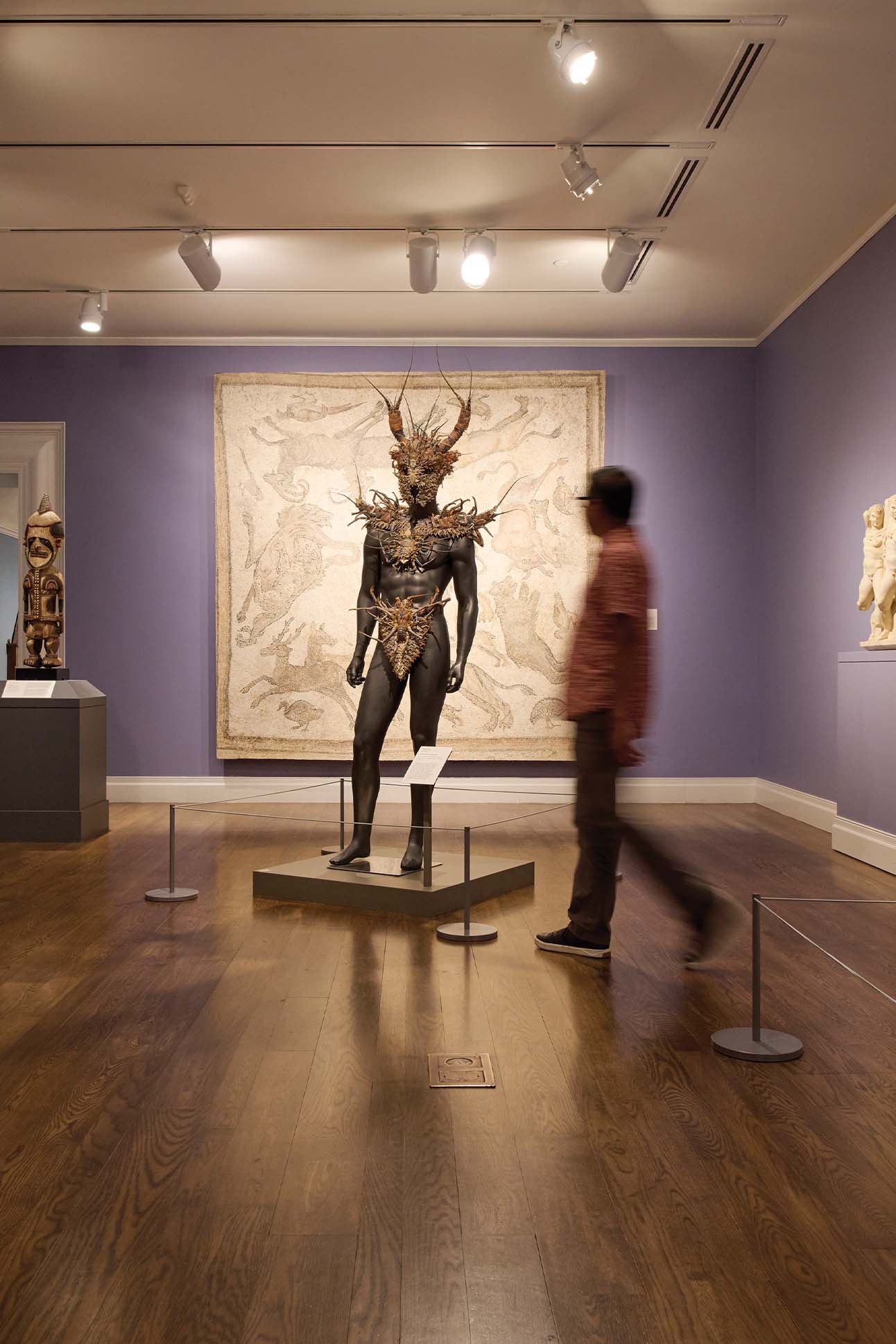
It is the kind of encounter that Aaron Padilla is dedicated to cultivating as the museum’s director of learning and engagement, a role he’s held since 2017. In the hands of the gallery interpretation team he oversees, insight isn’t confined to wall text; it unfolds through spatial design and, in this case, tactile elements that encourage physical interaction. Small but deliberate gestures transform observation into participation. Rather than simply presenting an artist’s work, the intention is to construct an environment that conveys the artist’s way of seeing the world.
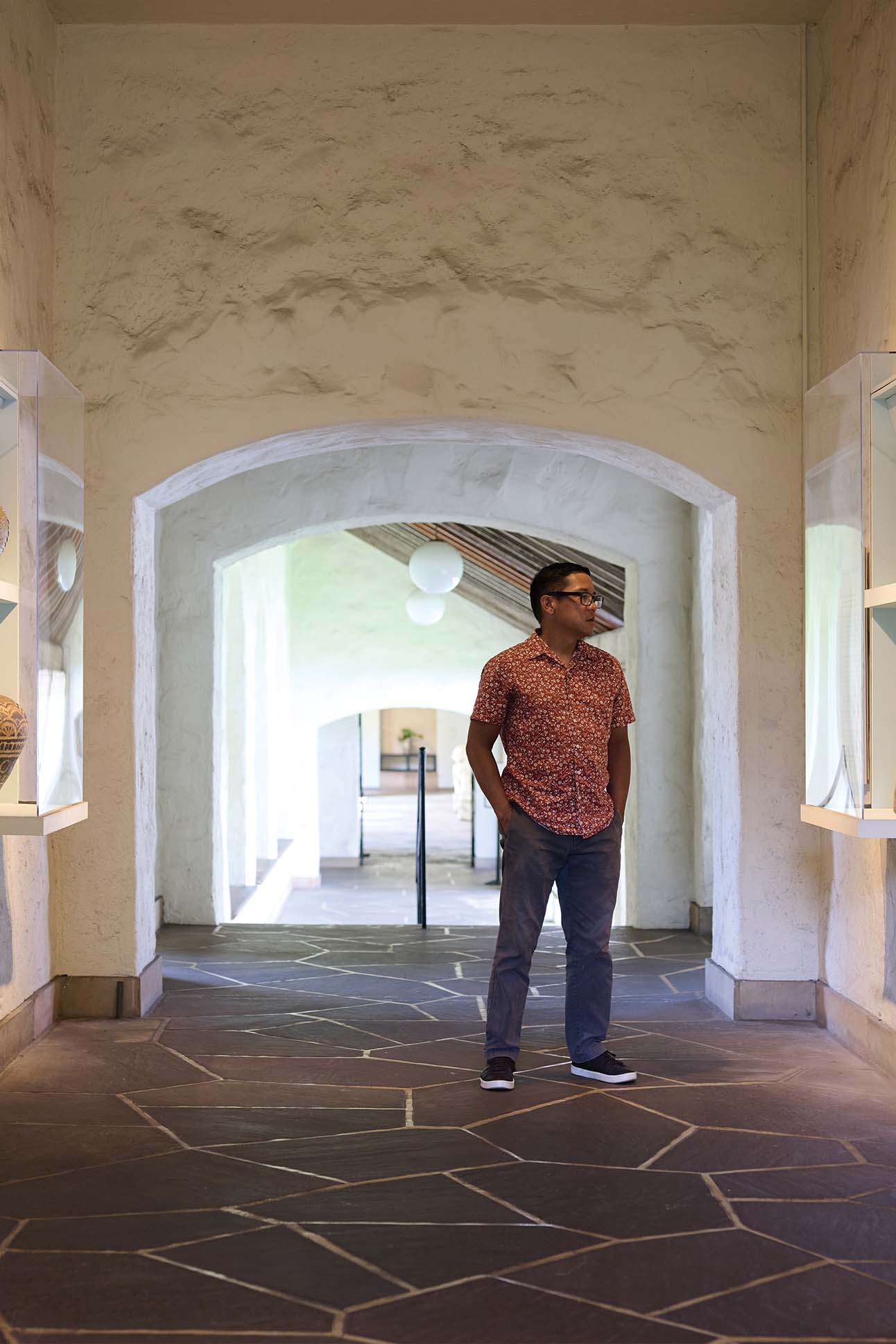
“The real, challenging, and sometimes uncomfortable work is understanding and playing with meaning that isn’t yours and finding a way to put that on display,” Padilla says. “We all have perspectives and biases; that’s part of being a human. I’ve found that success in this work is rarely about me or us at the museum. It’s about everyone else and the spectrum of perspectives that people carry with them.”
In 2008, while serving as an assistant curator at HoMA, Padilla was involved in developing All About Textiles, an exhibition designed as an interpretive tool for the museum’s textile collection. The exhibition incorporated tactile models and interactive materials related to weaving and knotting, and it proved formative in shaping Padilla’s approach to education, deepening his conviction that understanding emerges through doing.
That sensibility is also an undercurrent in Padilla’s own art-making. “Knots,” a body of work inspired by his childhood memories of learning to tie fishing hooks, is an exploration into the complexity of a seemingly simple form. In a statement about his “Knots” sculpture installed at Halepuna Waikiki, Padilla reflected, “My father would say, ‘This is how you do it, now practice.’ I would do it over and over, hundreds of times, until it became muscle memory. Until I could do it with my eyes closed. Until the obtuse and complex became clear and simple.”
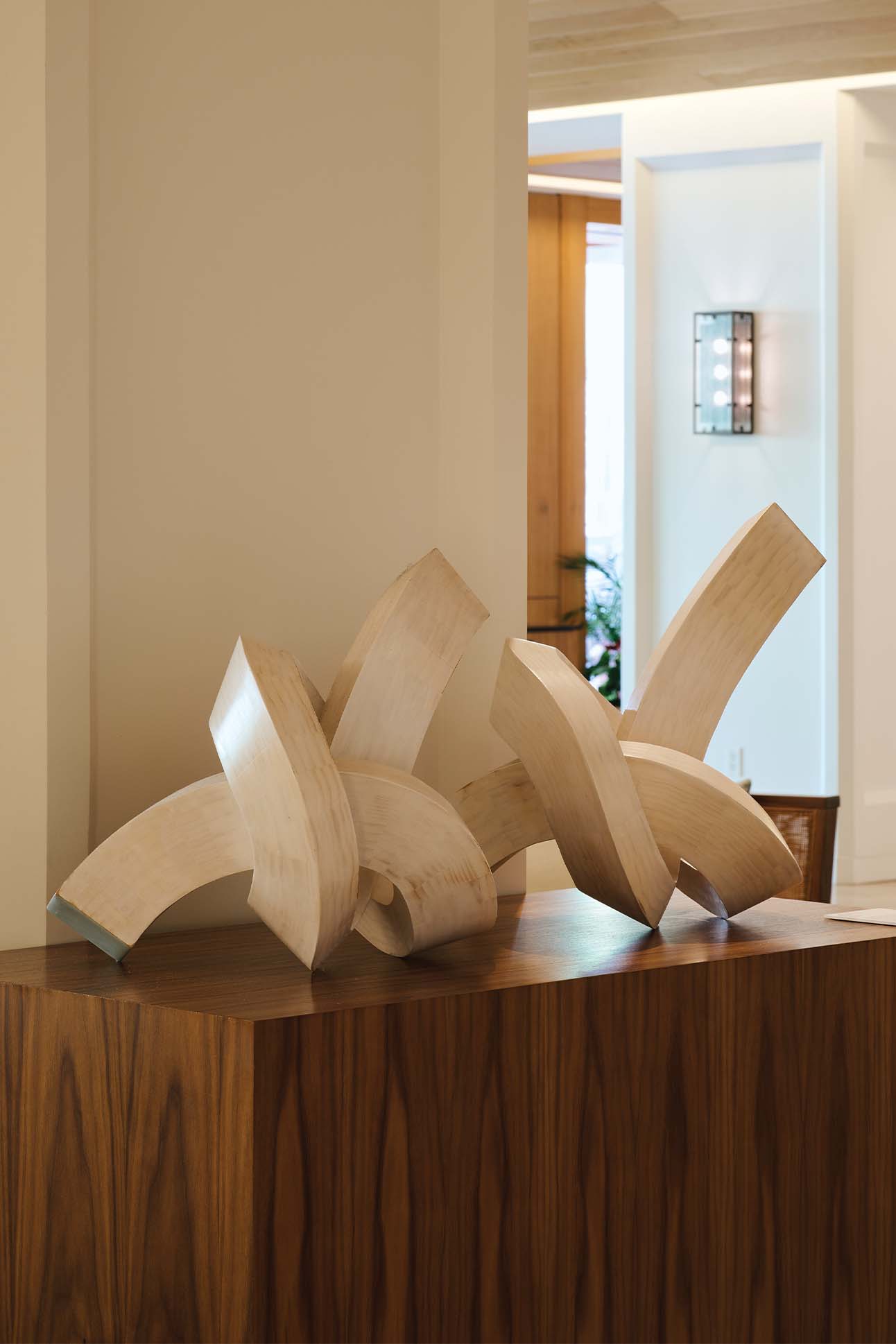
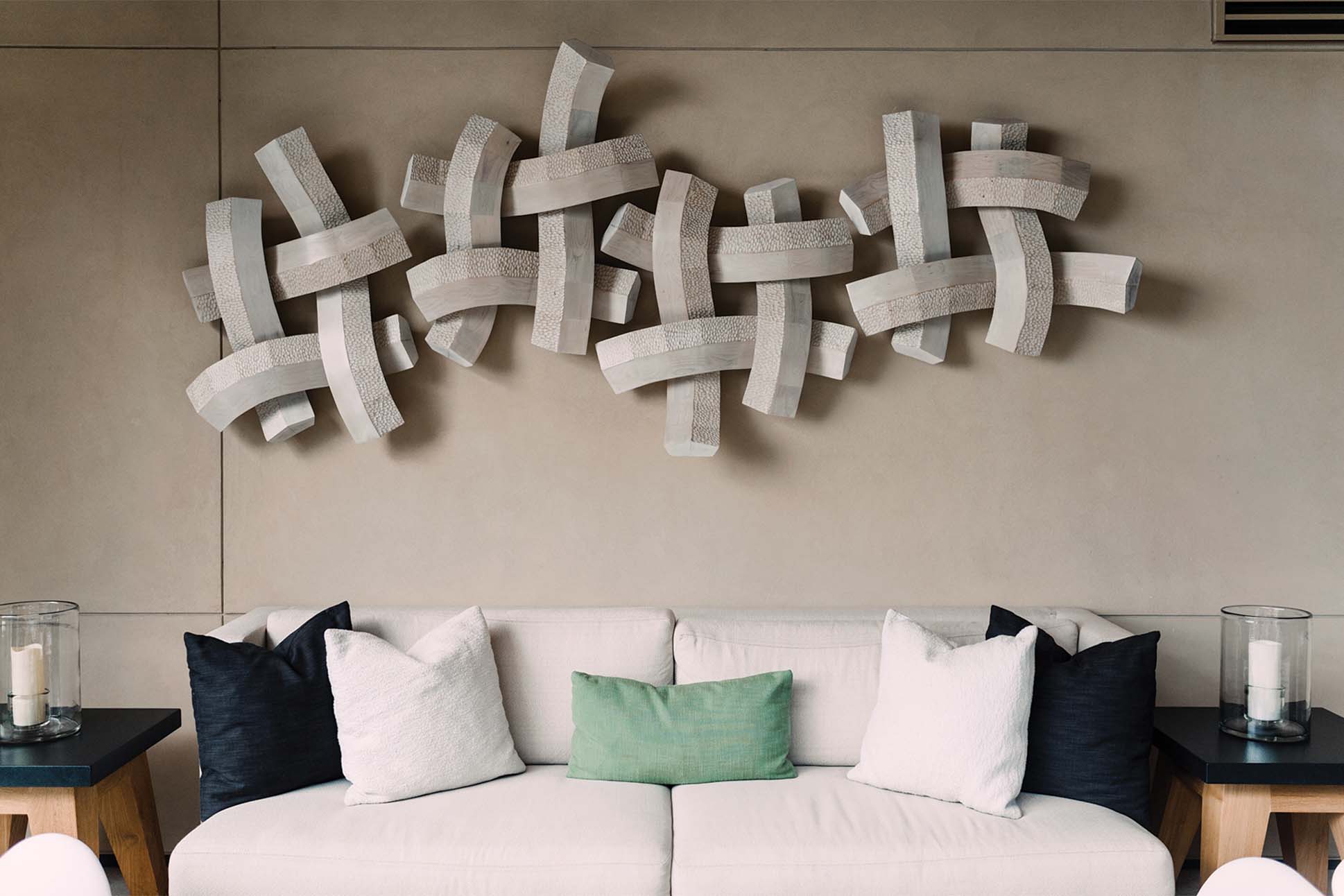
Another series of sculptures, developed over the last decade alongside his knot-based forms, evokes the interlocking structure of woven fibers. Like “Knots,” each sculpture is made from dimensional lumber that Padilla cuts into angled wedges and assembles piece by piece into fluid, sinuous shapes.
In a commission for Park Lane residences, Padilla combined his study of weave and knot diagrams with an earlier interest in representing thoughts, ideas, and conversations in physical form. “Years back, I did a commission for a wall sculpture that would be installed above some seating in a public space. I approached that project trying to represent the thoughts and conversations of the people who sat there, like thought bubbles in a comic strip,” Padilla says. “At Park Lane, they wanted something larger in scale than anything I had previously worked on, so it was important for me to make the work in separate modular pieces. In doing so, I ended up creating hashtags out of the four components to play off the notion [I’d been exploring] of ideas and conversations.”
Padilla’s materials are often deliberately modest: pine, maple, lumber, even whitewash. “As for the finish, I wanted to use something that was different and mundane and unexpected,” Padilla says. “Park Lane is so bougie—what if I used a finish that was so not that?” He landed on casein, or milk paint, better known as whitewash, a medium he’d learned to use from another local artist. “I found it to be a really great finish, particularly when polished, hardening over time and creating a surface with tremendous depth.”
The depth Padilla draws out of everyday materials echoes something central to his work at the museum. The challenge isn’t merely to capture attention, but to hold it there and reveal what might not be apparent at first, an endeavor he approaches as a creative practice in its own right. “My hope in everything I do has always been this: If I can make people slow down and look closer, both at something and within themselves—if I can make them wonder—then I did something right,” he says.
